
High Voltage vs Low Voltage Batteries
What are the differences between low voltage and high voltage batteries?
SOLAR ENERGYSTORAGE
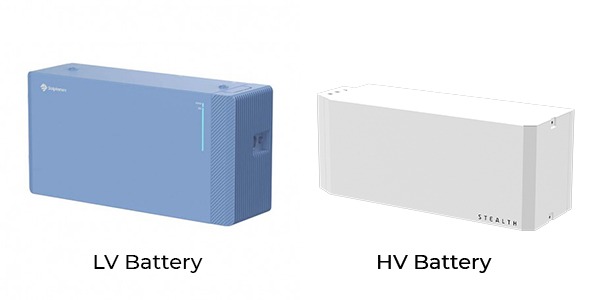
At Solar365 we install hybrid systems with high voltage (AV) and low voltage (BV) batteries, but what is the real difference and what advantages/disadvantages does each one have?
Advantages of high-voltage batteries in photovoltaic systems:
Greater energy efficiency
High-voltage batteries operate at lower currents for the same power output.
👉 Less current = lower heat losses (Joule effect).
Result:Improved charging and discharging efficiency
Less energy waste
Greater utilization of solar production
Improved compatibility with modern inverters
Most current hybrid inverters are designed to work with high-voltage batteries.
Key advantages:
More direct and stable communication
Improved system management
Higher overall battery-inverter performance
Greater available power
High-voltage (HV) batteries allow for greater instantaneous power delivery, which is crucial for:
Starting high-power appliances
Three-phase systems
Homes with high energy consumption
Small industries or businesses
With low-voltage batteries, this power output is usually more limited.
Less wiring and greater safety
By operating at lower current, high-voltage batteries require:
Smaller gauge cables
Less heat generation
Reduced risk of overloading
👉 This results in cleaner, safer, and more reliable installations.
Easier scalability
High-voltage battery systems are typically modular, allowing for capacity expansion:
By adding modules in series
Without major system modifications
While maintaining efficiency
Ideal if you start with a basic capacity and plan to expand in the future.
Longer lifespan in intensive use
Thanks to more efficient energy management and reduced electrical stress:
Better thermal control
Less degradation
More effective charge/discharge cycles
This is especially important for self-consumption with intensive daily use.
Ideal solution for advanced self-consumption
High-voltage (HV) batteries are the best option for:
Self-consumption with surplus energy
Backup systems
Homes with electric vehicles
Installations with advanced monitoring
When are low-voltage batteries suitable?
Although high-voltage (HV) batteries have clear advantages, low-voltage (BV) batteries can be suitable for:
Small installations
Simple off-grid systems
Tighter budgets
Applications with low power demand
Conclusion
High-voltage batteries offer greater efficiency, power, safety, and scalability, making them the preferred option in most modern photovoltaic installations. If the goal is to maximize the performance of the solar system and future-proof the installation, high voltage is clearly the best choice.
Say yes to green energy, but do it wisely!
Solar365
Energy efficiency solutions
Authorized installation company
CONTACT
Contact us or write to us at:
info@solar365.es
+34 644 569 437
© 2026. All rights reserved.
Follow us on social media:

Official Installer